

When discussing the selection of concrete batching plants, hopper type concrete batching plants are often simply categorized as "entry-level, low-capacity" options; few people systematically calculate the comprehensive cost advantages they offer over the entire lifecycle. As an industry professional who has long served small-to-medium-sized engineering clients, I have seen many projects discover—only after the equipment is put into operation—that maintenance and operating expenses far exceed the budget. It is precisely in this area that the hopper feeding design possesses market-underrated competitiveness.
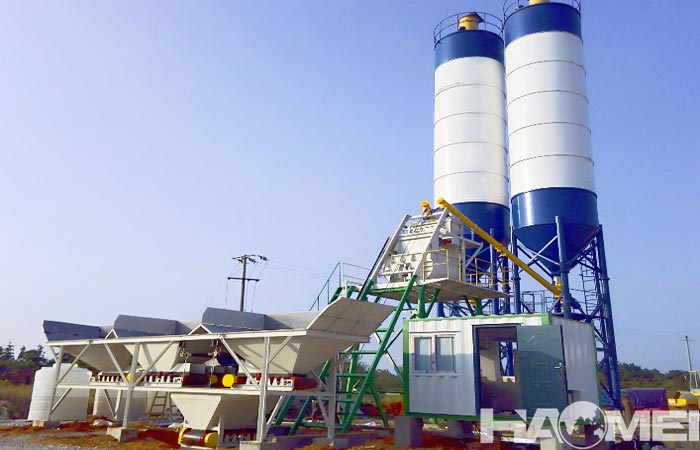
Hopper type concrete batching plants utilize a vertical skip-hoist system for material feeding. The core moving parts of the entire feeding system consist only of the winch mechanism, steel cables, the hopper, and guide pulleys. Compared to belt feeding models—which feature long conveyor belts, roller assemblies, tensioning devices, belt-tracking systems, and dozens of other wear-prone components—the number of moving parts is reduced by over 40%. Simpler structures mean fewer points of failure—a fundamental principle of mechanical design.
In harsh operating environments—such as the sandy, dusty conditions of the Middle East and Africa, or the high humidity of Southeast Asia—belt conveyor concrete batching plant equipment frequently suffers from issues like belt misalignment, seized rollers, and belt wear, often resulting in 15–20 days of downtime per year. Skip hoist concrete batching plants lack these exposed, continuously moving parts; their annual failure rate is approximately 50% lower than that of belt-fed models with equivalent capacity, resulting in higher equipment uptime. For overseas projects with tight schedules, avoiding even a single day of downtime prevents the loss of thousands of dollars in project progress payments—an implicit benefit that often far outweighs the initial price difference of the equipment itself.
The core wear-resistant components of a hopper feed concrete batching plant primarily fall into three categories: mixer liners, mixing blades, and hopper liners. Haomei’s entire range of hopper-fed plants utilizes thickened high-manganese steel. Under normal operating conditions, the service life of the mixer liners and blades exceeds 7,000 hours; based on an operation schedule of 8 hours a day and 250 days a year, the initial replacement cycle can extend beyond 3.5 years. The hopper liner plates feature a replaceable design; the cost of replacing a single liner is only about 0.5% of the total machine price, resulting in minimal daily maintenance expenses.
In contrast, belt-conveyor systems involve a wider range of wear parts—such as belts, idlers, drums, and scrapers—that require regular replacement, leading to annual consumable costs that are 20%–25% higher than those of hopper-fed systems. For remote overseas projects with limited budgets or restricted access to spare parts, this low-consumable design translates to reduced long-term operational pressure.
Many small-to-medium-sized projects are located in areas lacking professional mechanical maintenance technicians, making the daily upkeep of complex equipment a challenge. Hopper type concrete batching plants feature a simple, intuitive control system that retains core functions—automatic batching, mixing, and discharging—while eliminating complex logic like belt speed regulation and automatic alignment correction. Ordinary workers can operate the system independently after just three days of training.
Daily inspections are straightforward: checking wire rope wear, lubricating hopper rollers, and inspecting the main mixer's shaft-end seals. Weekly tasks include cleaning the batching machine gates, while monthly tasks involve tightening critical connection bolts. The entire operation and maintenance process can be handled by the project team itself without the need for professional technicians, significantly reducing reliance on external engineers.
Regarding initial investment, the purchase price of a hopper feeding concrete batching plant is 15%–20% lower than that of a belt-conveyor model of the same capacity, and civil engineering costs are reduced by approximately 35% due to the compact structure. Taking the HZS35 concrete batching plant model as an example, the main plant occupies an area of only about 9m × 5.5m and can be installed on a paved surface without requiring a heavy-duty concrete foundation, further minimizing upfront fixed costs. The modular equipment design allows for transport in standard shipping containers, keeping cross-border logistics costs manageable, while on-site installation and commissioning can be completed in just 5–7 days.
Years of project experience show that many customers focus solely on the base equipment price during selection, overlooking the costs associated with maintenance, spare parts, and downtime losses over a five-year lifecycle. The true value of a hopper type concrete batching plant lies in its use of a simple, reliable design to minimize uncertainty throughout its entire lifecycle—a level of certainty that represents a most valuable competitive advantage for small and medium-sized projects operating with tight budgets and limited technical resources.
About Us
| News
| Products
| Download
| Contact Us
Our job is much more than being construction equipment-concrete batching plant manufacturers,We are responsible to all the people who are concerned with this road and building construction industry and we strive to provide the best quality, price and services.
Address: No.14 Waihuan Road, New district, Zhengzhou, China.


