

Ready mix concrete plants and on site concrete batching plants represent the two primary models for concrete production in the construction industry. They differ significantly in terms of production methodology, quality control, operational efficiency and regulatory compliance. Selecting the appropriate model is critical, as it directly impacts construction quality, project timelines, and overall costs. Drawing on industry technical standards and Haomei Machinery’s extensive global project experience, this analysis provides a multi-dimensional comparison.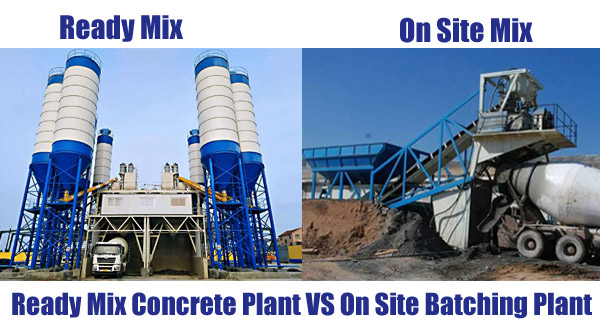
Quality Control Capability
Quality control capability is the fundamental differentiator between these two production models.
Ready mix concrete plants utilize an industrialized, centralized production approach equipped with precise electronic weighing systems. These systems maintain an aggregate weighing error of ≤±2%, and an error of ≤±1% for cementitious materials, mixing water and admixtures. Ready mix concrete plants feature standardized laboratories capable of testing raw materials, mixture properties, and strength indicators for every batch. This ensures that the 28-day compressive strength of the concrete remains stable, with fluctuations controlled within 4% and a strength coefficient of variation (CV) below 0.12. The resulting product offers consistent performance and full data traceability, meeting the stringent quality acceptance criteria required for high-specification engineering projects.
In contrast, on-site concrete batching plants often rely on manual or rudimentary weighing methods, where batching errors frequently exceed ±5%. These operations are highly sensitive to the skill level of the personnel involved; the coefficient of variation for concrete strength often exceeds 0.25, with strength fluctuations surpassing 8%. This frequently leads to issues such as inconsistent strength and poor workability. Furthermore, most on-site facilities lack professional testing capabilities, forcing operators to rely on subjective experience to determine mix proportions—a practice that carries a significantly higher risk to project quality.
Production Efficiency & Total Costs
There are also significant differences in production efficiency and total costs. Ready mix concrete plants feature fully automated production processes, with theoretical capacities ranging from 25 to 240 m³/h per plant. A single shift requires only 2–3 operators to manage the entire operation, meaning labor input per unit of output is just one-third that of on-site mixing. Centralized procurement and precise metering keep raw material waste to 2%–3%. Through large-scale production, the total cost per unit of concrete can be 10%–15% lower than that of on-site mixing. For an infrastructure project in a West African city, Haomei Machinery supplied an HZS120 ready-mix plant to serve multiple surrounding construction sections; calculations showed that the total cost per unit of concrete was 13% lower than if each section had set up its own on-site mixing facility, while the overall project timeline was shortened by 12%.
In contrast, on-site concrete mixing plants typically have a capacity of less than 20 m³/h and require multiple operators for tasks like loading, proportioning, and mixing, resulting in low labor efficiency. Open-air storage and manual loading lead to raw material (sand, aggregate, and cement) waste rates as high as 10%–15%. Furthermore, the need to build a separate batching plant for every project leads to redundant investment, resulting in significantly higher fixed costs per unit volume compared to the centralized ready-mix model.
Environmental Compliance
There are also clear distinctions regarding environmental compliance and resource utilization. Ready mix concrete plants come standard with enclosed silos, pulse-jet baghouse dust collectors, and three-stage wastewater recovery systems. In accordance with national standards, dust concentrations 50 meters downwind of the main equipment are kept at or below 10 mg/m³, and over 90% of production wastewater is recycled, ensuring consistent compliance with local environmental regulations. This centralized production model reduces the land footprint required at individual construction sites, leading to more efficient land use.
Conversely, on-site mixing plants often operate in open-air environments without systematic dust control or wastewater treatment, making it difficult to manage dust, noise, and sewage discharge. Many urban areas have now implemented policies restricting open-air mixing at construction sites, and failure to meet environmental standards can even lead to mandatory work stoppages for rectification.
Application Scenarios
In terms of application, ready mix concrete batching plants are well-suited for meeting stable, medium-to-long-term demand—such as commercial concrete supply in urban areas, large-scale infrastructure projects, and extensive real estate developments—with a typical supply radius of 15–30 kilometers. On-site batching plants, by contrast, are intended for scenarios where transportation costs are prohibitively high, such as in remote, hard-to-reach mountainous regions or for small-scale, scattered construction projects.
Haomei Machinery offers a comprehensive range of equipment, from simple, project-specific plants to large-scale commercial ready-mix facilities. We provide customized, optimal configurations tailored to the specific scale and requirements of each project, alongside end-to-end support—including site planning, installation and commissioning, and operational training—to serve projects across more than 60 countries and regions worldwide.
About Us
| News
| Products
| Download
| Contact Us
Our job is much more than being construction equipment-concrete batching plant manufacturers,We are responsible to all the people who are concerned with this road and building construction industry and we strive to provide the best quality, price and services.
Address: No.14 Waihuan Road, New district, Zhengzhou, China.


