

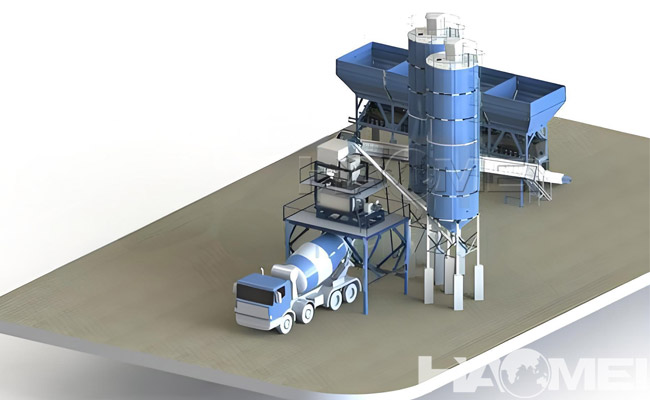
A ready mix concrete plant automatically weighs and intensively mixes raw materials—such as sand, gravel, cement, water, fly ash, and admixtures—according to a specific design mix ratio. The resulting concrete is then loaded into transit mixers for transport to the construction site.
A standard production workflow consists of:
Raw material acceptance → Categorized storage → Aggregate proportioning → Weighing of powders, water, and admixtures → Intensive mixing → Quality inspection → Loading and dispatch → Cleaning and maintenance.
The stability of a ready mix concrete plant’s production depends on three critical factors: the quality of raw materials, the accuracy of weighing, and the uniformity of the mixing process.
1. Raw Material Intake and Categorized Storage
Sand and crushed stone are delivered to the storage yard by dump trucks and stacked according to their specifications.
Common aggregates include:
0–5 mm: Manufactured sand or river sand;
5–10 mm: Small-sized crushed stone;
10–20 mm: Standard medium-sized aggregate;
20–40 mm: Used for specific foundation work or lower-grade concrete.
Cement, fly ash, and mineral powder are delivered by bulk tanker trucks and stored in silos. Ready mix concrete plants typically utilize silos with capacities of 100T, 150T, or 200T. These silos are generally equipped with pulse-jet dust collectors, pressure relief valves, and level indicators to prevent dust emissions during filling and to allow operators to monitor remaining material levels.
The moisture content of sand and gravel directly affects the slump of the concrete. For instance, the moisture content of sand might be 3% on a sunny day, but it could rise to 7% or higher following rain. If the control system continues to add water based on the original mix design, the resulting concrete will likely be too wet (too high a slump). Haomei Machinery offers optional moisture-detection systems for sand, which automatically adjust the amount of water added to the mix.
2. Automatic Aggregate Batching and Conveying
A loader feeds sand and gravel into the storage hoppers of a PLD-series aggregate batcher. Typical configurations vary based on the production capacity of the concrete batching plant:
|
Ready Mix Concrete Plant Model |
Common Batcher Model |
Number of Aggregate Bins |
|
HZS35 |
PLD1200 |
3 or 4 compartments |
|
HZS60 |
PLD1600 / PLD2400 |
3 or 4 compartments |
|
HZS90 |
PLD2400 / PLD3200 |
4 compartments |
|
HZS120 |
PLD3200 |
4 or 5 compartments |
Upon receiving production instructions, the control system sequentially opens the pneumatic gates of each aggregate bin. Sand and gravel fall into the weighing hopper, and the gates close automatically once the target weight is reached. The weighing accuracy for aggregates is typically maintained within ±2%.
Once weighed, the aggregates are transported to the main mixer via a skip hoist or a belt conveyor. HZS25 and HZS35 concrete plants often utilize a skip hoist, which requires a smaller footprint, while HZS60, HZS90, and HZS120 concrete plants generally employ belt conveyors, which are better suited for continuous production and higher output requirements.
3. Separate Weighing of Cement, Water, and Admixtures
While aggregates are being conveyed, other raw materials are weighed simultaneously.
Cement, fly ash, and mineral powder are transported from the bottom of their respective silos via screw conveyors to a powder weighing hopper. Clean water is pumped into a water scale or measured via a flow meter. Liquid admixtures—such as water-reducing agents or antifreeze—are delivered to an admixture scale using corrosion-resistant pumps.
Standard weighing accuracy for a typical concrete batching plant is generally as follows:
Aggregates: ±2%
Cement, fly ash, and other powders: ±1%
Water: ±1%
Admixtures: ±1%
When producing high-strength concrete (such as C40 or C50 grades), the precision and stability of admixture dosing are particularly critical. Excessive fluctuations in admixture dosage can lead to variations in slump, abnormal setting times, and may even adversely affect long-term strength.
4. Forced Mixing in a JS Twin-Shaft Mixer
All materials are fed into the JS twin-shaft mixer in a predetermined sequence. Inside the mixer, two counter-rotating shafts—equipped with mixing blades—propel the mortar and aggregates, ensuring they are continuously turned and blended so that the cement paste uniformly coats every aggregate particle.
Common mixer specifications include:
JS1000: Yields approximately 1 m³ per batch; typically paired with HZS50 or HZS60 concrete plants; motor power: 2 × 18.5 kW.
JS1500: Yields approximately 1.5 m³ per batch; typically paired with HZS75 or HZS90 concrete plants.
JS2000: Yields approximately 2 m³ per batch; typically paired with HZS120 concrete plants; motor power: usually 2 × 37 kW.
For standard ready-mix concrete, the mixing time is generally 45–90 seconds. For high-strength concrete, fiber-reinforced concrete, or mixes containing manufactured sand with a high fines content, this duration may be extended to 90–120 seconds.
Haomei Machinery once commissioned an HZS90 concrete bathing plant in Southeast Asia where the manufactured sand had a high stone-dust content, causing the concrete to form clumps during the initial mixing stage. By adjusting the feeding sequence—introducing aggregates into the mixer first for a pre-mix, followed by a portion of the water, and finally adding the cementitious materials and admixtures—and extending the mixing time by 15 seconds, the uniformity of the discharged concrete was significantly improved.
5. Quality Testing and Loading into Transit Mixers
Once the mixing process is complete, the hydraulic discharge gate opens, and the concrete is discharged into a waiting transit mixer.
Before leaving the plant, technicians typically perform spot checks on the following parameters:
Slump or slump flow;
Concrete temperature;
Air content;
Unit weight (density);
Preparation of compressive strength test specimens.
A delivery note is generated for each truckload, recording the strength grade, volume, mix design reference number, project name, departure time, and the transit mixer’s identification number. Modern control systems can store batch data, facilitating quality traceability and client billing. After concrete is loaded, the drum of the concrete transit mixer must continue to rotate at a low speed. In cases of high ambient temperatures, long-distance transport, or traffic congestion, dispatchers should regulate the departure schedule to prevent the concrete from segregating or undergoing initial setting during transit.
6. Post-Shift Cleaning and Routine Maintenance
Once production concludes, operators must promptly clean the main mixing unit, discharge gate, receiving hopper, and the loading area on the vehicles. If residual concrete is allowed to harden, it becomes significantly more difficult to remove and accelerates the wear of mixing blades, liner plates, and the discharge gate.
Key aspects of routine maintenance include:
Inspecting mixing blades, liner plates, and shaft-end seals;
Calibrating scales for aggregates, powders, water, and admixtures;
Checking for conveyor belt misalignment, material buildup on rollers, and lubrication of the reduction gearbox;
Cleaning screw conveyors and dust collectors on powder silos;
Inspecting pneumatic systems, solenoid valves, sensors, and control cabinets.
Haomei Machinery offers configuration solutions for HZS35, HZS60, HZS90, and HZS120 ready mix concrete plants, tailored to your project’s daily output requirements, aggregate specifications, site dimensions, and local voltage standards. We provide comprehensive support, including foundation drawings, layout plans, remote installation guidance, and export packing schedules. Please share your project location, required daily output volume, and aggregate details to receive a customized technical proposal and quotation.
About Us
| News
| Products
| Download
| Contact Us
Our job is much more than being construction equipment-concrete batching plant manufacturers,We are responsible to all the people who are concerned with this road and building construction industry and we strive to provide the best quality, price and services.
Address: No.14 Waihuan Road, New district, Zhengzhou, China.


