

Setting up a concrete batching plant involves significant upfront costs beyond the mere purchase price of the equipment. The total concrete batching plant setup cost comprises five key components: equipment, civil works, site costs, auxiliary facilities, and working capital. Return on Investment (ROI) is determined by capacity utilization, local commercial concrete prices, and operating costs. Drawing on Haomei Machinery’s extensive data from overseas project deliveries, the following analysis presents a cost and return calculation based on HZS180 commercial concrete plant.
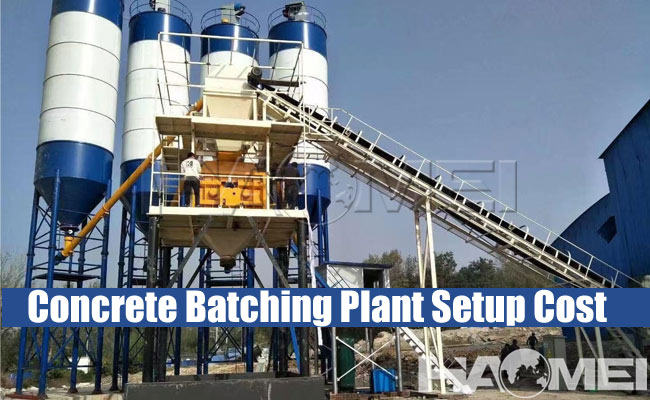
Regarding equipment procurement, the standard HZS180 concrete batching plant configuration includes a twin-shaft JS3000 mixer, four 1,000-ton cement silos, a four-bin aggregate batcher, a belt conveyor system, and a pulse dust collection system. The 2026 FOB factory price ranges from approximately US$152,000 to US$198,000; when factoring in ocean freight, tariffs, inland transport, and on-site installation and commissioning, the total landed cost for the equipment is approximately US$220,000 to US$280,000.
Civil works—including equipment foundations, silo support foundations, enclosed material sheds, three-stage sedimentation tanks, and vehicle washing platforms—cost approximately US$80,000 to US$150,000 based on standard overseas specifications (costs may increase by 20% due to poor geological conditions or construction during the rainy season).
Site costs cover a total plant area of approx. 1–1.3 hectares, with annual rent or amortized land purchase costs ranging from US$30,000 to US$60,000.
Regarding auxiliary facilities and working capital: if concrete mixer trucks and pump trucks are company-owned, additional investment is required (outsourcing these services excludes them from the plant site investment); initial raw material stockpiling and personnel staffing costs are approximately US$50,000 to US$80,000.
In summary, the total construction investment for a standard HZS180 commercial concrete plant ranges from US$380,000 to US$570,000, while the cost for a small HZS50 concrete batching plant can be reduced to US$120,000–US$180,000.
Based on the HZS180 concrete batching plant actual stable output of 150 m³/h, an annual operating schedule of 250 days, and a single 8-hour shift, the theoretical annual capacity is approximately 300,000 m³. With an industry-average capacity utilization rate of 60%–70%, actual annual sales volume ranges from 180,000 to 210,000 m³. Calculated using a commercial concrete price of $80–$110/m³ in markets across Asia, Africa, and the Middle East, annual operating revenue is estimated at $14.4 million–$23.1 million.
Operating cost breakdown: raw materials (sand, gravel, cement, and admixtures) account for 65%–75% of the selling price; labor accounts for 5%–8%; equipment depreciation (calculated via the 8-year straight-line method) accounts for 3%–4%; fuel and electricity account for 4%–6%; environmental compliance and maintenance account for 2%–3%; and administrative and sales expenses account for 5%–8%. The overall net profit margin typically falls within the 8%–15% range.
Based on the above information, the annual net profit for a standard HZS180 concrete batching plant ranges from $1.15 million to $3.45 million, with a median value of approximately $2 million. With a total construction investment of $480,000, the static payback period is approximately 2.5–3.5 years; this can be reduced to under two years if capacity utilization exceeds 70%. Conversely, if utilization falls below 45%, the payback period extends beyond five years, placing the project in a high-risk zone.
Practical experience with overseas projects indicates three core variables determining ROI:
First, the saturation of local commercial concrete demand (requiring a pre-investment survey of planned residential, municipal, and infrastructure projects within the surrounding area over the next three years);
Second, the density of concrete plants within the transport radius (in highly competitive areas, net profit margins can be compressed to below 5%);
Third, the ability to source raw materials locally (reliance on external transport for cement, sand, and gravel increases costs by 10%–20%, directly eroding profits).
For the initial investment, it is recommended to prioritize medium-sized HZS90–HZS120 concrete batching plants, as the balance between equipment investment and production capacity is better suited to county-level markets. Expanding to HZS180 concrete batching plant only after demand has been validated can reduce both upfront sunk costs and payback-period risks by approximately 40%.
About Us
| News
| Products
| Download
| Contact Us
Our job is much more than being construction equipment-concrete batching plant manufacturers,We are responsible to all the people who are concerned with this road and building construction industry and we strive to provide the best quality, price and services.
Address: No.14 Waihuan Road, New district, Zhengzhou, China.


