

As a sales manager who has long been involved in the construction equipment market, I have observed that the demand for concrete batching plants in Kenya has a strong localized characteristic. It's not simply of standard European and American models; rather, it's about creating a clear product needs based on local infrastructure development, power grid conditions and climate. Currently, the core competitiveness of concrete batching plants for sale in Kenya has never been about how high-end their specifications are, but rather their ability to adapt to the urban-rural construction scenarios and limited supporting infrastructure.
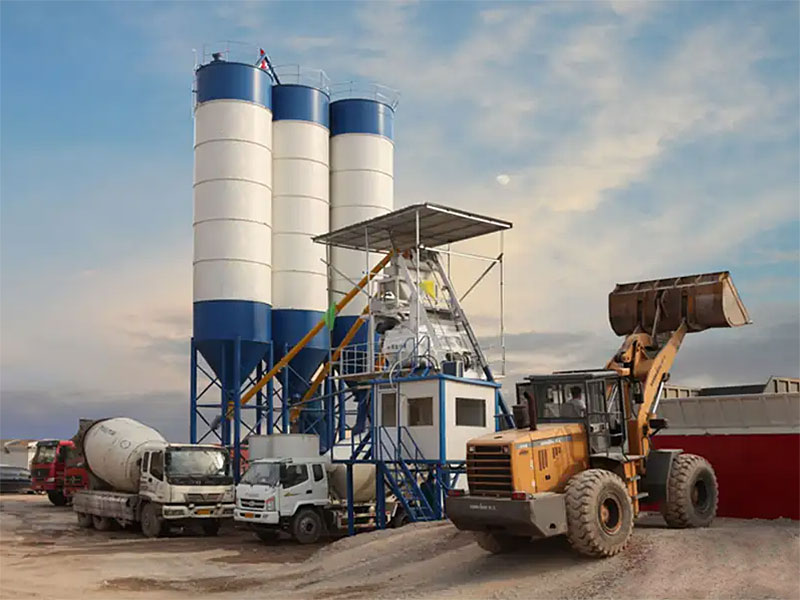
The mainstay of rural and remote projects is small hopper-type and mobile concrete batching plants with a capacity of 25-50 m3/h. Many road networks, irrigation systems, and rural housing projects in Kenya are scattered in remote areas, making the transportation cost of ready-mixed concrete extremely high, reaching thousands of dollars per trip. Furthermore, insufficient power grid coverage and frequent power outages are commonplace. These small-capacity models perfectly match the demand: the compact hopper structure, with the HZS35 concrete batching plant model occupying only about 50 square meters, allows for installation on hardened ground, and civil engineering costs are 35% lower than belt-driven models, making it ideal for small-scale contractors in rural areas. The mobile concrete batching plant model, integrated on a steel chassis, can be towed and relocated, and can be put into operation in 2-3 days. One unit can cover multiple scattered construction sites, increasing the reuse rate by over 60%. Both models can be equipped with diesel generator sets for power supply, adapting to off-grid construction scenarios; the core configuration remains unchanged, featuring a standard JS series twin-shaft main unit with metering accuracy meeting EN 206 standards, capable of stably producing C10-C40 grade concrete, fully meeting the quality requirements of rural infrastructure.
The mainstream choice for urban and medium-sized projects is a compact stationary concrete batching plant with a capacity of 60-90 m3/h. In cities like Nairobi and Mombasa, building and municipal projects are larger in scale, but site availability is generally limited, and the local industry generally defines concrete batching plant 60 m3/h as "large capacity," far exceeding the specifications commonly used in rural projects. Most mainstream models on the market adopt a modular design, allowing for easy disassembly and transport using standard containers, enabling on-site production in approximately 7 days. Designed for Kenya's hot, dusty tropical climate, the cooling system is redundantly designed for an ambient temperature of 50°C. The electrical control cabinet and main unit shaft end are upgraded with multi-layered sealing and dustproof structures, effectively reducing the risk of malfunctions caused by dust. Taking the HZS60 concrete batching plant model as an example, paired with a JS1000 main unit and continuous belt conveyor, the actual production rate remains stable at over 85%, producing over 400 cubic meters of material per 8 hours, perfectly covering the supply needs of medium-sized municipal and residential projects.
From personal experience, the most common pitfall when purchasing concrete batching plant for sale in Kenya is ignoring local operating conditions and blindly pursuing high specifications. When selecting a mixing plant, the highest priority is not theoretical capacity, but three points: First, power supply compatibility—prioritize models that support the local 415V/50Hz voltage and are compatible with diesel generator sets; second, dustproofing and heat dissipation—in the tropical, dusty environment, sealing and heat dissipation design directly determine the equipment's lifespan; and third, parts commonality—maintenance capabilities are weak in remote areas, and common wear parts can significantly shorten downtime.
Overall, the demand for concrete batching plant for sale in Kenya is rapidly stratifying, but the core logic remains "sufficient, durable, and easy to maintain." Haomei Machinery's customized models for the East African market are optimized around these three core pain points: power supply, dustproofing, and maintenance. Compared to general-purpose models, they are more suitable for the local construction environment and are a popular choice among local small and medium-sized contractors.
About Us
| News
| Products
| Download
| Contact Us
Our job is much more than being construction equipment-concrete batching plant manufacturers,We are responsible to all the people who are concerned with this road and building construction industry and we strive to provide the best quality, price and services.
Address: No.14 Waihuan Road, New district, Zhengzhou, China.


