

Selecting a concrete batching plant supplier is a critical decision prior to project commissioning; it directly impacts the equipment’s lead time, operational stability, and the return on investment (ROI) over entire lifecycle. Drawing on over a decade of global experience in equipment delivery and technical services, Haomei Machinery suggests that buyers evaluate concrete batching plant suppliers based on five key dimensions: capacity alignment, quality control systems, service capabilities, total lifecycle costs, and past project references.
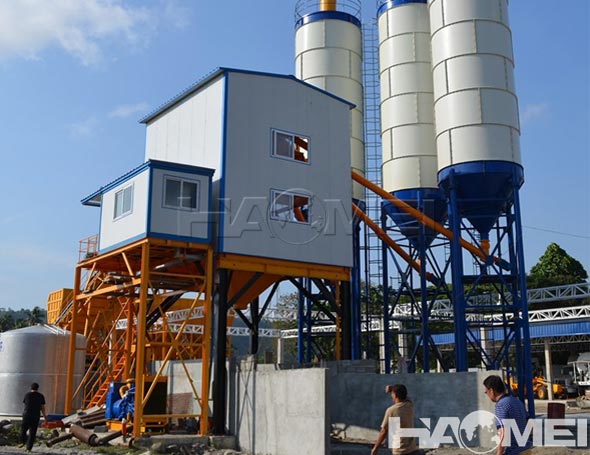
Precise alignment of production capacity and configuration is the foundation.
Buyers should calculate the required capacity based on the project’s total volume and construction timeline, incorporating a 10%–15% buffer—before selecting from a concrete batching plant supplier’s product range. In the industry-standard HZS series concrete batching plants, the suffix number indicates the theoretical hourly capacity. Reputable manufacturers adhere to the GB/T 10171-2016 standard, with actual stable output typically reaching 80%–90% of the nominal capacity. During procurement, it is essential to verify the detailed list of core components—distinguishing between standard and optional items—to avoid "bait-and-switch" tactics where low initial quotes are followed by mandatory, additional costs. For instance, a standard HZS180 concrete batching plant typically includes a JS3000 twin-shaft mixer, four 1000-ton powder silos, and a pulse-jet dust collection system. Some suppliers may lower their quoted price by reducing the number of silos or downgrading the dust collection system; however, the subsequent cost to upgrade these components can exceed 20% of the original purchase price. Haomei Machinery maintains full transparency regarding its equipment configurations, ensuring that all standard specifications meet industry requirements, while also offering customized layout solutions tailored to specific project needs.
Evaluating quality control and the performance of core components.
It is advisable to prioritize concrete batching plant manufacturers with independent design and production capabilities, focusing specifically on the quality standards of the mixing unit and the weighing/metering system. According to national standards, the liner plates of a forced-action mixer should have a service life of at least 40,000 batches; high-quality concrete batching plant manufacturers utilize high-chromium alloy materials, which can extend this lifespan to over 80,000 batches. Furthermore, the static calibration error for the weighing system should be kept within ±0.5%—a standard that surpasses the industry-typical tolerance of ±1%. Pay close attention to the welding processes and anti-corrosion treatments used for steel structures. The paint film thickness on the equipment is ≥80μm, ensuring suitability for harsh operating environments, such as those with high humidity or high salinity. Haomei’s production lines utilize CNC cutting and robotic welding; all critical components undergo comprehensive inspection before leaving the factory, resulting in an equipment service life of 10–15 years.
Evaluating delivery capabilities and localized service support.
Buyers should verify a concrete batching plant supplier’s experience with export logistics and their local service network—covering aspects such as FOB delivery timelines, customs clearance documentation, on-site installation guidance, and the availability of spare parts. Many small-to-medium-sized manufacturers in the industry lack a permanent overseas service presence, often requiring 7–15 days to respond to equipment failures—a delay that can result in production losses of tens of thousands of dollars per day. Haomei Machinery maintains service hubs and spare parts warehouses across Southeast Asia, Africa, and the Middle East. Standard spare parts can be delivered to a project site within 48 hours, and technical personnel are available to respond to on-site needs within 24 hours. For instance, in a commercial batching plant project in East Africa, Haomei successfully diagnosed and repaired a major equipment failure within 24 hours, significantly minimizing downtime losses.
Calculating the total cost is an effective way to avoid the "low-price trap."
Procurement decisions should not focus solely on the initial purchase price; they must account for 5–8 years of operational and maintenance (O&M) costs, energy consumption, and spare parts expenses. While initial quotes for equipment of the same capacity may vary by only 10%–15%, lower-quality equipment can incur annual O&M costs that are 20%–30% higher, ultimately leading to a higher total cost over the equipment's lifecycle. Haomei’s equipment consumes 8% less electricity per unit of output compared to the industry average, and its wear parts feature a standardized design—reducing procurement costs by 15% below the industry average—which offers a significant advantage for long-term operations.
Finally, when selecting, verify its performance through existing projects in similar environments. Prioritize concrete batching plant suppliers with a proven track record in the same region and at a similar scale, allowing for either on-site or remote assessment of the equipment’s actual operating condition. Haomei Machinery has delivered over 1,000 concrete batching plant units globally across more than 50 countries and regions, and can provide prospective buyers with references to actual projects featuring the same models in relevant geographic areas.
About Us
| News
| Products
| Download
| Contact Us
Our job is much more than being construction equipment-concrete batching plant manufacturers,We are responsible to all the people who are concerned with this road and building construction industry and we strive to provide the best quality, price and services.
Address: No.14 Waihuan Road, New district, Zhengzhou, China.


