
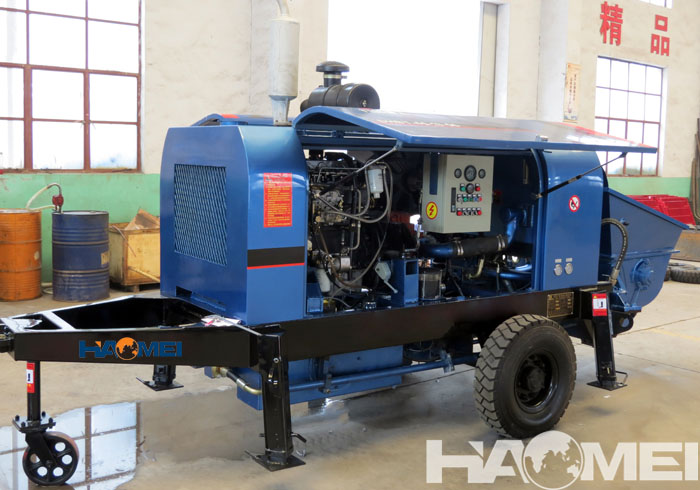
For infrastructure contractors, buy trailer concrete pumps is a core equipment decision that directly impacts construction efficiency and return on investment. Currently, the price difference for the same displacement equipment in the market can reach 30%, reflecting fundamental differences in configuration, reliability, and service capabilities. As a concrete equipment exporter with deep global market experience, we have combined our experience from deploying over 600 units trailer concrete pumps overseas to outline a professional purchase logic from four dimensions: working condition matching, configuration selection, cost accounting, and delivery assurance. This helps clients avoid selection pitfalls and choose high-performance, cost-effective equipment that truly meets their needs.
Step 1: Anchoring working condition parameters, selecting the right displacement and power configuration.
The core principle of selection is "sufficient with a margin," rather than blindly pursuing a large displacement. A common industry rule is that the actual output of the equipment is approximately 70%-80% of the theoretical displacement; this should be used to deduce the required model. For rural residential and small-scale municipal projects with a daily pouring volume of 60-80 m3, a 30-40 m3/h trailer concrete pump model is sufficient. For mid-rise buildings and long-distance pipeline construction, a 60 m3/h high-pressure model is recommended to ensure an outlet pressure of over 16 MPa to handle vertical transmission needs of 180 m and horizontal transmission distances of 500 m. The power configuration should be chosen based on site conditions: for urban projects with a stable power grid, electric versions are preferred, as they consume 25%-30% less energy than diesel versions and are easier to maintain; for remote areas without electricity, diesel versions are mandatory, and it is essential to ensure the engine meets the emission standards of the target market to avoid customs clearance issues.
Step 2: Identify core components and maintain equipment reliability.
Cost-cutting in low-priced equipment often focuses on core components that are not easily noticed by customers, directly affecting the equipment's overhaul cycle. Prioritize models with an S-tube valve distribution structure and a 3mm hard alloy layer welded to the inner wall. The spectacle plate and cutting ring are inlaid with YG8 alloy, offering a service life of up to 30,000 cubic meters under normal operating conditions, double that of ordinary welded models. For the hydraulic system, choose a dual-pump, dual-circuit open design, with independent oil circuits for the main pump and valve swing, reducing potential failure points by 30%. Continuous operation allows for stable oil temperature control below 75℃, suitable for high-temperature conditions in Southeast Asia and the Middle East. Also, confirm whether a fully automatic centralized lubrication system is installed, providing quantitative grease injection based on pumping frequency to avoid shaft end wear caused by manual lubrication omissions.
Step 3: Calculate the total life cycle cost, not just the purchase price.
The purchase cost of engineering equipment only accounts for about 30% of the total life cycle cost; energy consumption, replacement of vulnerable parts, and downtime losses are the core expenditures. Based on 200 operating days per year and an average daily pouring volume of 50m3, the annual energy cost of the electric trailer concrete pump is approximately 65% of that of the diesel trailer concrete pump, allowing for a recovery of the power system price difference within three years. While high-quality wear-resistant parts are 20% more expensive to purchase, their lifespan is doubled, resulting in a 40% reduction in annual maintenance costs. More importantly, reliability is crucial: a single blockage or component failure at an overseas construction site can lead to downtime and labor losses exceeding the cost of half a set of wear-prone parts. Choosing a model with mature configurations essentially reduces the risk of downtime.
Step 4: Confirm export delivery and localization support capabilities.
Hidden costs in cross-border procurement often lie in delivery and after-sales service. Regarding certifications, it is necessary to confirm that the manufacturer possesses basic certifications such as CE (compliant with EN 12001 safety standards for concrete conveying machinery) and ISO9001, and can handle customs clearance certificates such as SONCAP and PVC required by the target country. For transportation, prioritize models with a width ≤2.5m and height ≤2.5m, which can be directly loaded into a 40-foot standard container without the need for special containers, saving over 40% in per-container sea freight costs. In terms of after-sales service, it's essential to confirm that the manufacturer can provide English operation manuals and fault codes, remote technical support, and global express delivery capabilities for common-specification consumable parts to avoid prolonged downtime due to equipment failure.
Overall, the core logic for buy trailer-mounted concrete pump is "working condition matching as the foundation, reliable configuration as the core, and delivery service as the guarantee." As a professional trailer concrete pump manufacturer, we can provide customized selection solutions based on the client's project scenario and target market, covering the entire service chain from equipment selection and certification to sea freight customs clearance and technical support, ensuring efficient production immediately upon equipment installation.
About Us
| News
| Products
| Download
| Contact Us
Our job is much more than being construction equipment-concrete batching plant manufacturers,We are responsible to all the people who are concerned with this road and building construction industry and we strive to provide the best quality, price and services.
Address: No.14 Waihuan Road, New district, Zhengzhou, China.


